Gerald Wade’s unfinished letter to Loraine
The Seven Dials MysteryGerald Wade’s unfinished letter to Loraine Wade is both a private message and a crucial piece of evidence: dated the night before Gerald Wade was found dead, it records his warning about Seven Dials and his claim to be well, a claim that sits uneasily beside his fatal chloral dose. Recovered by Bundle Brent and later read by Jimmy Thesiger, the incomplete page turns an intimate communication into a puzzle whose missing ending matters as much as its surviving words.
Recovery and Dating
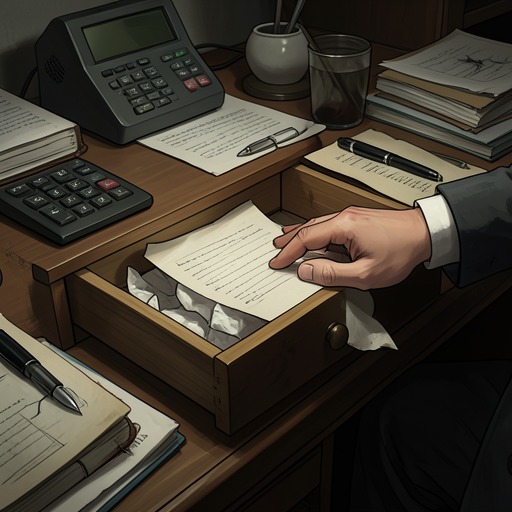
Bundle Brent finds the letter while searching an inlaid writing desk with a lid that rolls back. Its lower part has jammed halfway, as it had on a former occasion when an envelope was pushed back with the drawer. This time Bundle uses a thin paperknife in the narrow crack; a corner of white paper appears, and she draws out the somewhat crumpled first sheet. The recovery is physical and piecemeal: the desk gives up a concealed fragment, not a complete account.
The date catches Bundle’s attention before the letter’s contents: “Sept. 21st.” She connects it to the following day, when Gerald Wade was found dead, and concludes that he must have been writing the letter on the evening of the tragedy. The dating gives the page an immediacy its unfinished form cannot resolve. It brings the reader close to Gerald’s last known writing without explaining what happened after he put down the pen.
Bundle’s surroundings reinforce that connection. She is in the room where Gerald died, and, after reading the letter, imagines that he might be watching her. The only sound is the ticking of her little gold clock, which seems unnaturally loud. The clock does not explain the death; it makes the interval between the dated page and the discovered body feel newly present as Bundle reads.
Affection and the Warning
The letter begins “My Darling Loraine,” establishing its intimate address, and says that Gerald will be down on Wednesday. He reports feeling “awfully fit” and “rather pleased” with himself, then says that seeing Loraine will be “heavenly.” These ordinary, warm assurances make the page sound like a personal message before its subject changes. They also become important because Bundle knows how Gerald died: the letter presents a man who says he feels well on the very evening associated with his fatal dose of chloral.
The most consequential passage concerns Seven Dials. Gerald asks Loraine to forget what he had said about it, explaining that he had thought it would be “more or less of a joke” but that it was not a joke at all. He apologizes for having mentioned it and says it is not business that “kids like you” should be mixed up in. His wording establishes both that Loraine has been told something about Seven Dials and that Gerald now wants her removed from the matter. It does not disclose what he told her, what the business involves, or why he changed his view.
That warning gives the letter its investigative force. Bundle does not initially know what Seven Dials means; she associates the words with a district of London and senses that they remind her of something else, but cannot immediately identify it. The letter therefore supplies a specific lead without supplying its solution. Its intimate appeal to Loraine and its unexplained reference to Seven Dials pull in different directions: Gerald writes to someone close to him, yet asks her to forget the very information that makes the letter useful to the inquiry.
The Unfinished Page and Its Contradiction
After the warning, Gerald writes that there is something else he wants to tell Loraine, but that he is so sleepy he cannot keep his eyes open. He then begins another thought—“Oh, about Lurcher; I think -”—and the page breaks off. The surviving sheet thus contains two distinct gaps: an intended disclosure introduced but not delivered, and a sentence cut short at the point where it names Lurcher. Neither gap can be completed from the letter itself.
The statement about sleep troubles Bundle most. She contrasts it with Gerald’s assertion that he feels fit and with her knowledge that he took such a heavy dose of chloral that he never woke again. If his account of feeling well is true, she reasons, why did he take it? The letter does not establish whether his words were sincere, whether the sleepiness had an ordinary explanation, or how the chloral came to be taken. Its evidentiary value lies in exposing the contradiction, not resolving it.
The unfinished form also limits what the page can prove. It is the first sheet of a letter, not a complete record of Gerald’s thoughts or of his communication with Loraine. The abrupt end leaves the proposed further disclosure and the reference to Lurcher open, while the warning about Seven Dials remains general. The page offers a dated voice and a pointed clue, but withholds the context needed to interpret either fully.
Circulation and Narrative Role
The letter moves from the desk where Bundle finds it into the developing investigation. When Loraine is about to speak, Bundle raises the subject of the letter and explains how she found it. Jimmy Thesiger listens with keen interest; this is the first he has heard of the document. Loraine takes it from her bag and hands it to him, and after reading it he asks what Gerald wanted her to forget. The same words that first unsettle Bundle therefore become a question put directly to Loraine.
That transfer changes the page from a private message into shared evidence. Bundle’s discovery identifies the date and contradiction; Jimmy’s reading focuses attention on the warning and its intended recipient. The letter does not disclose Loraine’s answer in this moment, but it places her knowledge at the center of the next inquiry. Its importance rests in that combination of proximity and incompleteness: it is written on the eve of Gerald Wade’s death, addressed affectionately to Loraine Wade, and explicit enough to point toward Seven Dials while stopping short of explaining it.